The train was late. The date was wrong. A solar-storm mystery moves to 1848.
A railway that did not yet exist helped researchers expose a seven-year error in a famous space-weather account.
The train really may have been delayed by space weather. The problem was the date. Researchers revisiting a famous account of railway disruption in Exeter found that the reported 1841 event described a line that did not open until 1846.
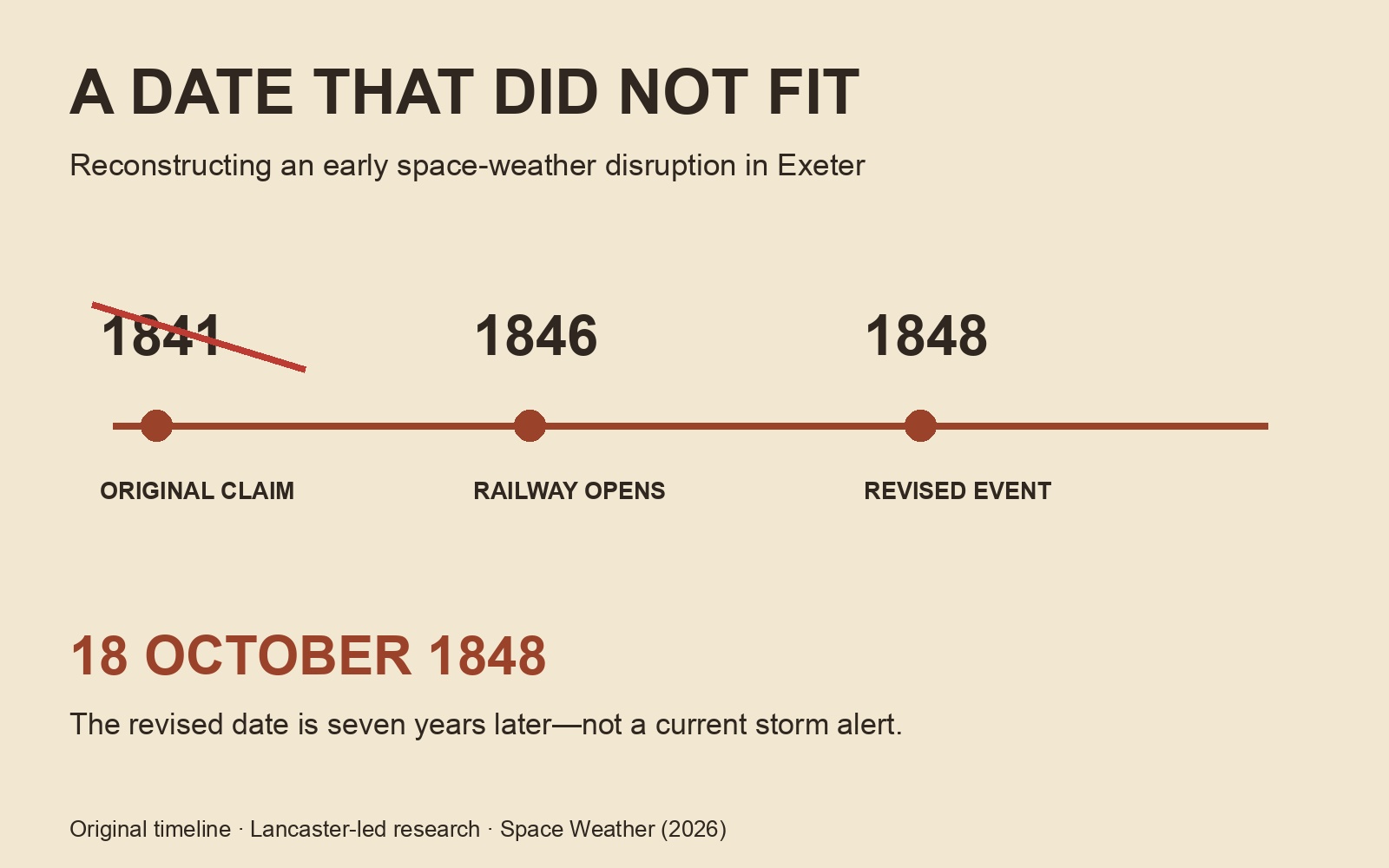
Their investigation points instead to October 18, 1848, moving the episode seven years forward. The study appeared in Space Weather and was covered on October 21. It is a historical reconstruction of one of the earliest technological disruptions linked to solar activity—not a warning that a similar train failure is happening now.
The clue was a railway that did not yet exist
An anonymous account published in Nature in 1871 described intense magnetic disturbance on October 18, 1841. It connected the event to disrupted railway signalling and a 16-minute delay to a scheduled 10:05 p.m. departure from Exeter.
The later researchers found a basic chronological obstacle: the Exeter-to-Starcross line named in the story opened in 1846. Whatever the account was describing, it could not have happened on that particular railway five years before the line existed. That inconsistency gave them a reason to re-examine a date that had been repeated in the scientific record.
Reconstructing an evening across different archives
The team compared railway timetables and newspaper reporting with accounts of auroras, records of solar activity and digitized magnetic observations. Those sources pointed to the 1848 date rather than the original 1841 claim.
That method matters because a plausible story is not enough to fix a historical error. Independent records must line up. Railway history checks whether the infrastructure existed; timetables check the journey; astronomical and magnetic records test whether the space-weather setting fits. The strength comes from combining evidence that answers different parts of the question.
Why the corrected date changes the record
Moving Exeter to 1848 means it can no longer be described as the earliest known case simply because the older date once appeared in print. The researchers instead identify telegraph interference on Britain's Midland Railway in March 1847 as an earlier documented incident.
The Exeter story remains valuable. It sits near the beginning of society's reliance on electrical communications, when a natural phenomenon that had always existed began interacting with a newly expanding technological network. Losing an earliest-ever label does not remove its significance.
How the Sun reaches an electrical system
Solar activity can disturb Earth's magnetic environment. Changes in that environment can produce unwanted electrical currents in long conducting infrastructure and interfere with systems that rely on stable electromagnetic conditions.
The best-known nineteenth-century example is the Carrington Event of 1859, which disrupted telegraph systems and produced remarkable auroras. The Exeter investigation concerns an earlier episode. Combining the two into a single storm would erase the very historical distinction the researchers were trying to establish.
Old records are useful for modern risk
Today's vulnerable systems include power networks, satellite communications, navigation and railway signalling. The technologies are different from an early telegraph network, but the wider lesson remains: infrastructure operates within a changing space environment.
That is not a prediction of an imminent blackout. The study reconstructs the past and helps build an evidence base for understanding a longstanding hazard. A claim about a current solar-storm threat would need a current official forecast, not merely an interesting historical parallel.
The accompanying timeline is an original explanatory graphic, not a photograph of an 1848 train or an aurora witnessed that night. Preserving that distinction is especially important when a dramatic illustration could make a reconstructed event appear directly documented by a camera. Here, the drama is in the evidence: a date that did not fit, a line that had not opened and the archival work that brought the story back into alignment.
A correction can make a story more useful
Scientific history is sometimes presented as a neat list of firsts. This case shows why those lists need checking. A single date can make an event look earlier than the infrastructure required for it. Repetition across later accounts does not independently verify the original claim.
The researchers did not need to discard every detail of the Exeter account because one part was wrong. They tested whether a different date reconciled the railway, the timetable and the geophysical evidence. That is a stronger approach than either accepting the whole story unchanged or treating the contradiction as proof that no disruption occurred.
Readers should carry the same distinction into modern science coverage. A revised detail does not automatically erase an entire finding, but it can change the specific claim a headline is allowed to make. Here, the useful correction is seven years—and the loss of an earliest-ever label.