The one-metre mystery: city birds fled women sooner than men in a European study.
Across 37 species and 2,701 observations, the pattern held. Researchers still do not know which cues explain it.
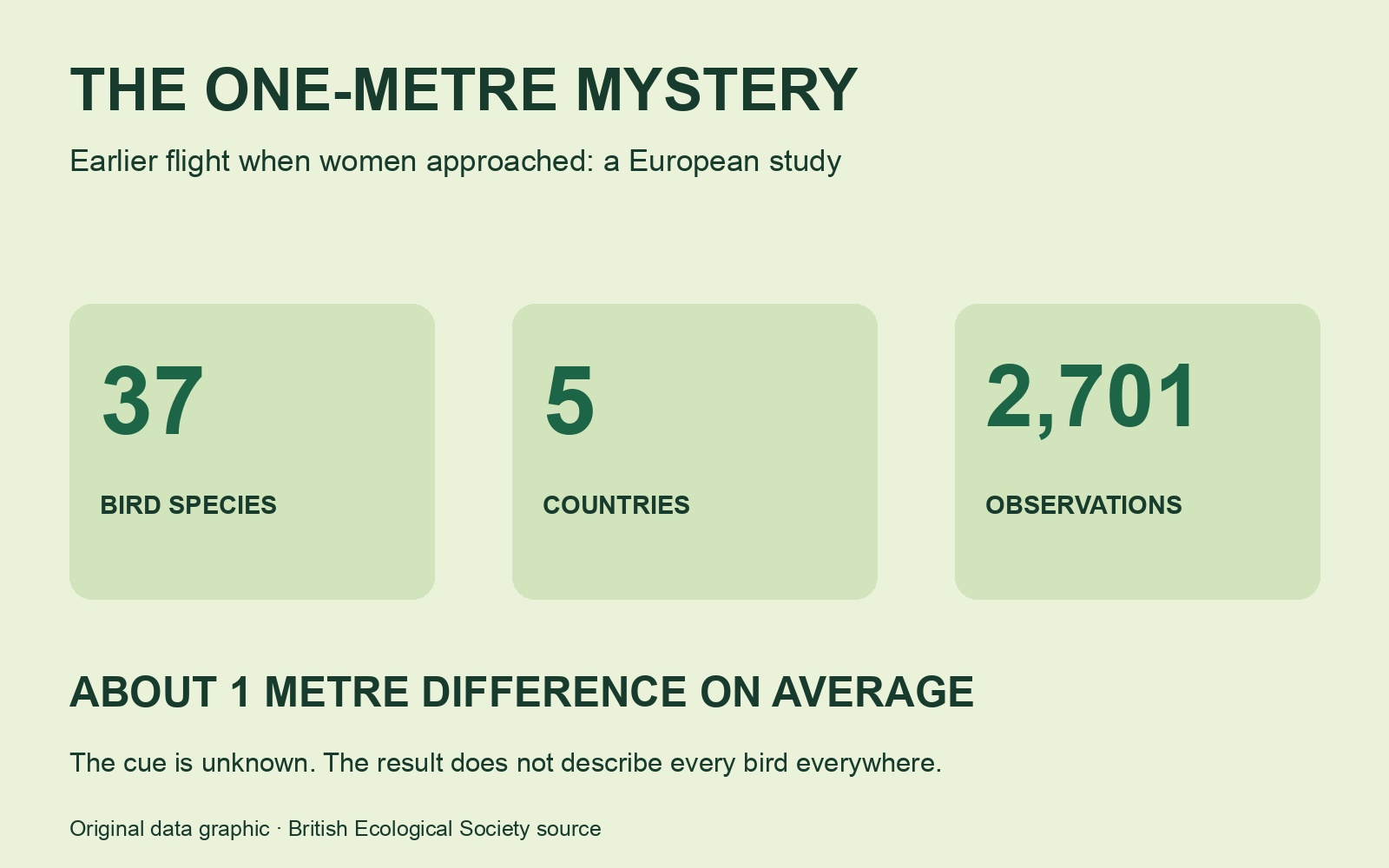
A person walking toward a city bird might seem like a neutral research instrument. In a study spanning five European countries, that assumption did not hold: birds took flight sooner when approached by women than when approached by men.
Across 2,701 observations involving 37 species, men could get about one metre closer on average before the birds flew away, according to the account supplied by the British Ecological Society and covered on October 22. The finding is unusual. The mechanism remains unexplained, and the result is not a claim that every bird everywhere behaves the same way.
The measurement was distance, not a bird's opinion
Researchers used flight initiation distance: how close an approaching person gets before a bird takes off. It is a measurable behavioural response, not a direct reading of an animal's thoughts or a ranking of which people it likes.
Participants matched for height and clothing approached birds in urban parks and other green spaces. The countries were Czechia, France, Germany, Poland and Spain. Species included great tits, house sparrows and blackbirds, as well as birds with different usual responses to people.
One metre is an average difference
The reported gap does not mean every individual bird allowed every man to stand exactly one metre closer. An average summarizes a set of observations with variation inside it. A particular pigeon encountered tomorrow cannot be expected to reproduce the average on command.
The researchers said the overall pattern was consistent across the cities and species they examined. That makes it worth investigating, but it does not remove the need to test other places, populations and conditions. The geographical scope was European cities, not a global survey of all birds or all habitats.
What might the birds be detecting?
The authors discussed possibilities including differences in movement, body shape and chemical cues. Those are hypotheses, not mechanisms demonstrated by the study. A suggestion involving scent should not become a headline declaring that scientists proved birds can identify a particular human hormone.
Matching height and clothing reduces some obvious differences between observers. It does not isolate every characteristic that could vary between individuals. To identify a cue, researchers would need experiments that alter a specific feature while holding other relevant conditions as steady as possible.
The observer may be part of the experiment
The methodological lesson reaches beyond a curious wildlife headline. When people measure animal behaviour, the animals can react to the people taking the measurements. If observer characteristics influence the result, treating all observers as interchangeable could overlook a source of variation.
That does not make the research worthless or mean one group should be excluded from fieldwork. It creates a reason to record observer information, design comparisons carefully and test potential influences openly. The source itself points to implications for both urban ecology and assumptions about neutrality in science.
What the finding does not justify
It does not show that women are more dangerous to birds, that men are kinder to wildlife or that birds understand human social categories in the way people do. It identifies a behavioural association under the study's conditions. Turning it into a judgment about people would go well beyond the evidence.
The underlying journal reference dates the research to 2025; the October 2026 coverage brings renewed attention to it. The central scientific question remains open: birds reacted differently, but the study does not establish which cues caused that difference.