45.22 kilometres on Mars: Perseverance takes the driving record.
AutoNav helped NASA’s rover pass Opportunity’s total in about five and a half years. The reward is access to more ancient terrain.
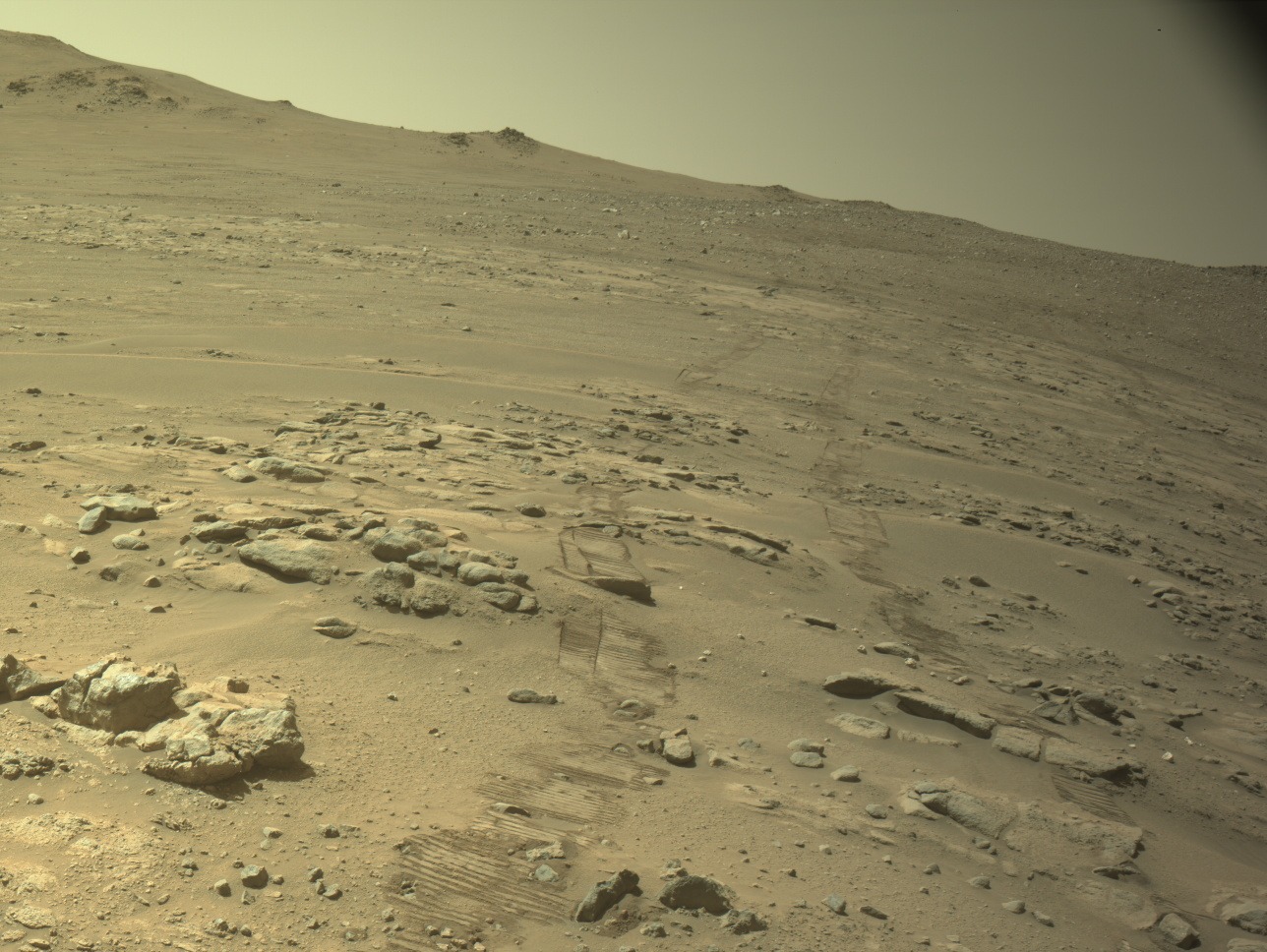
Perseverance has taken the off-world driving record, but its most interesting destination is not a finish line. NASA's rover is heading through ancient terrain outside Jezero Crater, where greater mobility gives scientists access to more of Mars' geological history.
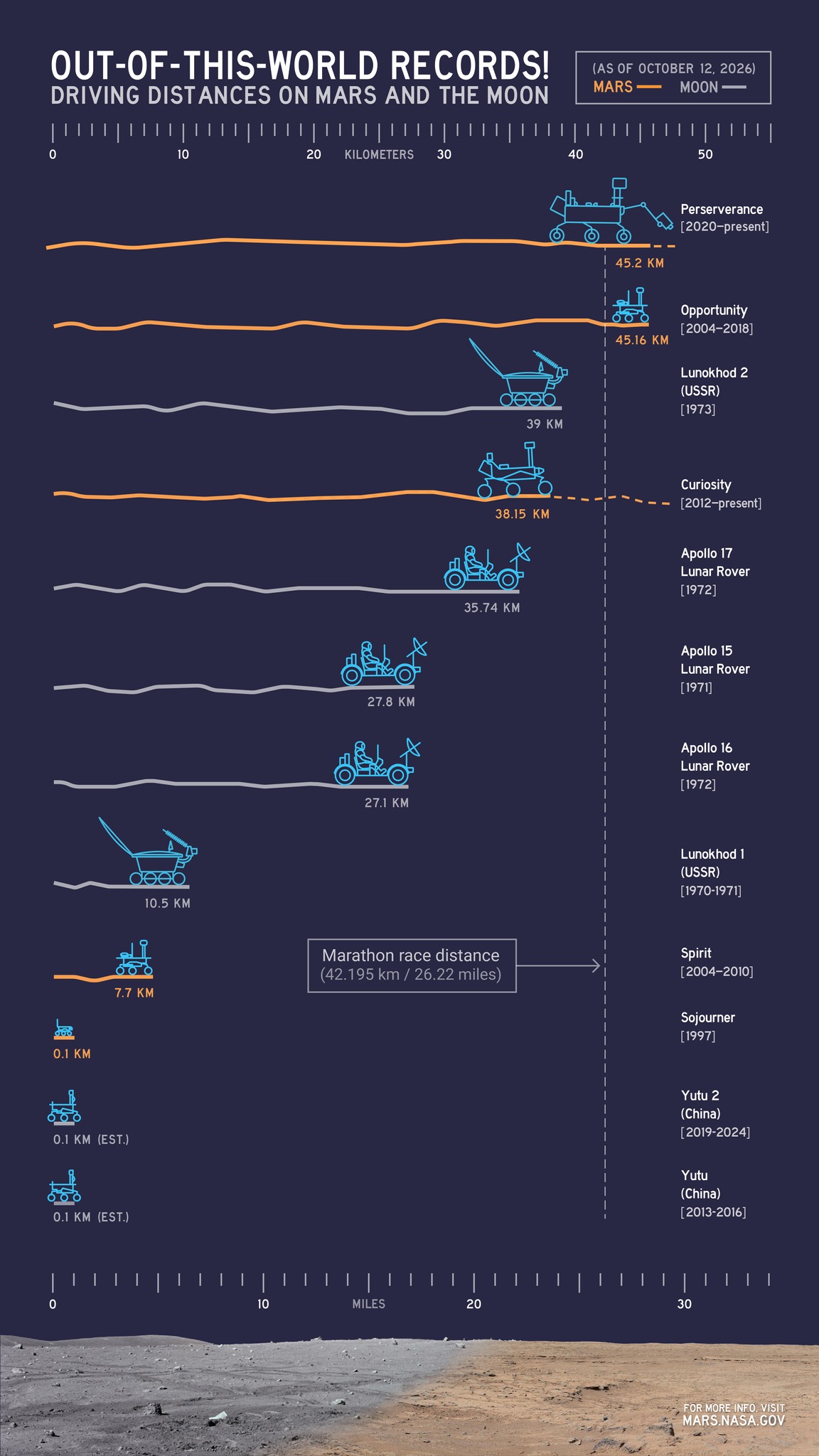
On October 11, its odometer reached 28.10 miles, or 45.22 kilometres, passing Opportunity's 28.06 miles, or 45.16 kilometres. NASA announced the milestone on October 12. Perseverance reached it on mission sol 2,006, after about five and a half years; Opportunity accumulated its distance over nearly 15 years.
The record in numbers
The gap at the moment of the record was modest: 0.04 miles, approximately 60 metres using the rounded kilometre figures. The significance is not a sudden enormous jump ahead, but the new mission's ability to reach the distance much more quickly.
Perseverance also passed earlier lunar totals along the way. NASA lists 22.2 miles for the Apollo 17 lunar rover and 24.2 miles for the Soviet robotic Lunokhod 2. These comparisons concern cumulative driving on another world's surface. They are not records for spacecraft flight distance or the speed of travel between planets.
A rover that evaluates the road while moving
A major reason for the progress is AutoNav, Perseverance's autonomous navigation system. It takes images, builds a three-dimensional picture of hazards and chooses a route between waypoints selected by planners on Earth. NASA calls the process thinking while driving.
The agency says AutoNav has evaluated terrain for more than 90% of Perseverance's driving distance. Early autonomous navigation on Spirit and Opportunity assessed about 5%. Perseverance processes roughly 600,000 measurement points each time it examines the terrain, compared with 20 for the much smaller Sojourner rover in 1997.
Those figures describe different generations of navigation capability, not proof that human controllers no longer matter. Mission teams still select scientific objectives and destinations, review operations and work within the rover's constraints. Autonomy helps execute a journey across terrain where continuous joystick control from Earth is not the operating model.
The destination is older than the odometer
The record came as the rover approached an area called Idubi through Lac de Charmes, beyond Jezero's western rim. The science team is interested in traces of ancient hydrothermal systems—places where heated water may once have circulated through rock.
Such environments matter because water, heat and rock chemistry can help scientists reconstruct whether conditions were potentially habitable. A potentially habitable environment is not the same as evidence that organisms lived there. The route can put promising rocks within reach without settling the question of Martian life.
Twenty-nine samples, several ancient environments
NASA reported that Perseverance had collected 29 samples of rock and regolith, the loose material covering the surface. Their settings span the crater floor, deposits associated with an ancient river system and the crater rim.
Some rocks in the rim region formed during impacts around four billion years ago. Comparable chapters of Earth's early history have often been altered or erased by erosion and plate tectonics. Mars offers different preservation conditions, which is part of the reason scientists value a rover capable of visiting multiple outcrops rather than remaining near one landing spot.
More driving is approved—but not unlimited
NASA says the first mission extension began in October and supports crater-rim exploration through roughly the end of 2028. A future target is Rainbow Falls, a block of ancient crust around 100 metres wide that was uplifted by the impact that formed Jezero.
There are still practical limitations. Sun glare can interfere with navigation cameras, and the team is working on ways to improve driving under those conditions. A record does not mean the landscape has become easy. It means the vehicle and its operators have built a more capable way to cross it, putting the next scientific question a little closer.
Why a faster route changes the science
For a rover team, reaching more sites is a way to compare environments. A lakebed, a river deposit and an impact-exposed block of crust do not preserve the same geological story. Mobility helps researchers test how one location relates to another instead of interpreting a planet from a single patch of ground.
NASA's account describes the original mission as calling for no more than 12.4 miles of driving. Passing 28 miles therefore also reflects performance beyond the initial distance plan. It does not mean every component has unlimited life: operators still have to plan around hardware, terrain, power and the availability of useful light for navigation.
The life-search question stays open
The rover previously examined Cheyava Falls, a rock containing features described as a potential biosignature. Potential is the essential word. A pattern that could be associated with biology must still be distinguished from features that nonbiological processes can produce.
The new record does not upgrade that possibility into a discovery of life. It expands where the mission can investigate and how many geological settings it can compare. That is a substantial achievement on its own, even when the largest question remains unanswered.