Six inches can knock you down. A flooded road is not a depth test.
National Weather Service guidance explains why familiar routes and taller vehicles do not make floodwater safe to enter.
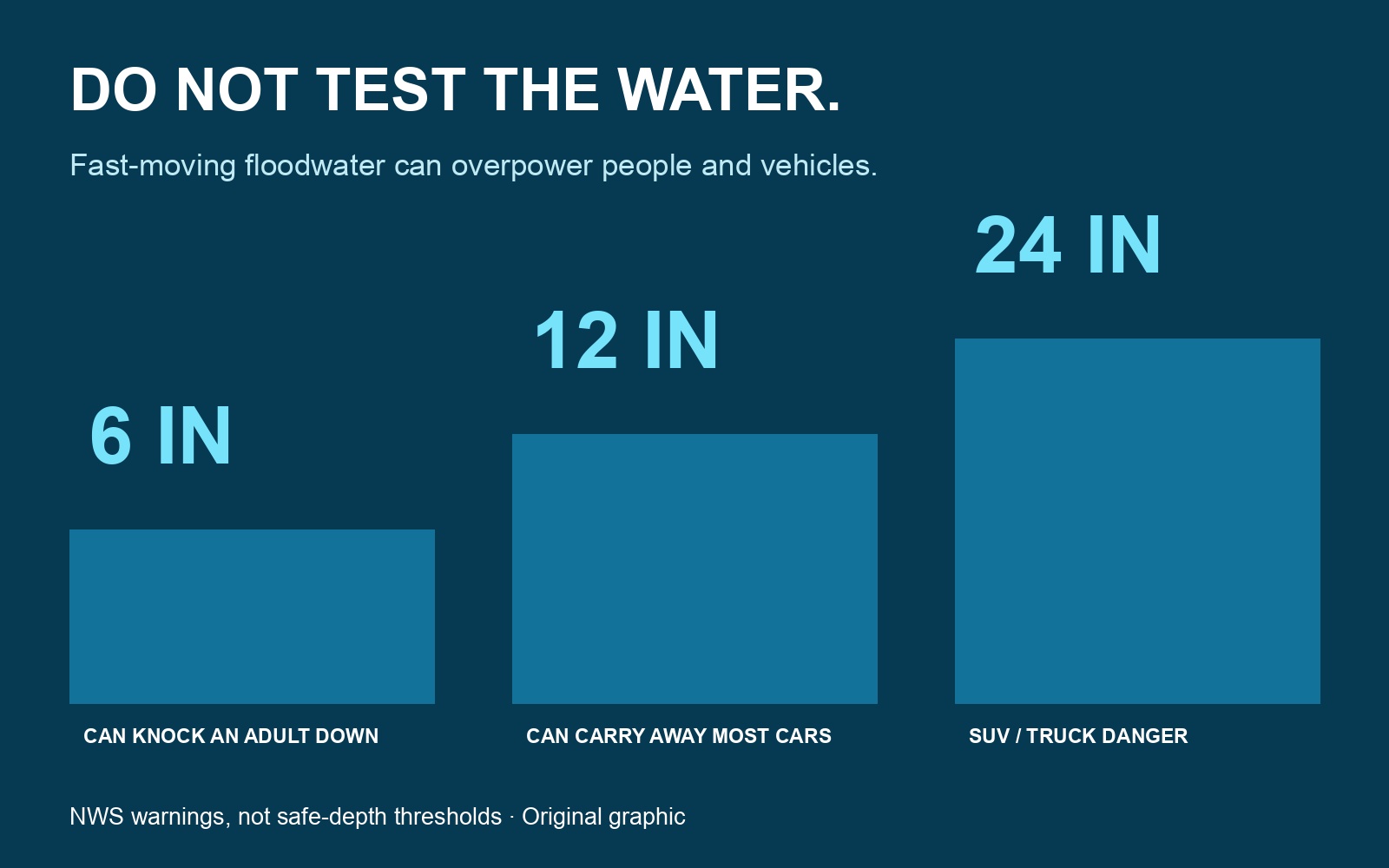
Six inches of fast-moving floodwater can knock an adult off their feet. Around 12 inches of rushing water can carry away most cars. Those are warnings from the US National Weather Service—not minimum depths below which a crossing becomes safe.
Floodwater can conceal a missing road surface, a deep channel or a current that is stronger than it looks. This safety explainer draws on the service's Turn Around Don't Drown guidance. It is not a live report of a specific flooded road, and its illustrations are not photographs of a new local emergency.
Why the familiar road is no longer familiar
A driver may know the usual dip, kerb or lane markings along a route. Once water covers them, that knowledge cannot show whether the road underneath remains intact. Flooding can damage the surface or wash supporting material away.
The water also hides objects and changes in depth. A stretch that appears shallow near the edge can be much deeper farther along. Neither a photograph from another driver nor the fact that a different vehicle crossed earlier establishes the conditions at the moment you arrive.
What the six-inch warning means
The National Weather Service says a mere six inches—about 15 centimetres—of fast-moving floodwater can knock over an adult. The important words are fast-moving: depth is only one part of the danger, alongside speed, footing and the surrounding terrain.
The same guidance warns that 12 inches, roughly 30 centimetres, of rushing water can carry away most cars. It gives two feet, approximately 61 centimetres, as a warning for SUVs and trucks. These rounded public-safety figures are not a vehicle-by-vehicle guarantee. They do not make a lower measurement safe to test.
A large vehicle does not change the instruction
An SUV's height can make a driver feel protected, but the recommendation is still not to enter floodwater. A high seating position does not show the road underneath, eliminate current or establish that the vehicle will remain controllable.
Do not drive around barriers placed across a flooded road. Their purpose is to keep people out of a dangerous area; they are not an invitation to judge whether your own vehicle is an exception. Choose a safe alternative route or wait somewhere safe for official information.
Getting out of the route matters more than the schedule
If a trip would require crossing a flooded section, a delay is preferable to entering it. Do not walk through the water to inspect the crossing or try to rescue a stalled vehicle on your own. Conditions can change quickly, and going in can create another emergency.
If you are in immediate danger, contact local emergency services—911 in the US or 999/112 in the UK—and follow their instructions. This report cannot assess the safest action inside a particular stranded vehicle or flooded building. The correct response can depend on water movement, available exits and other hazards.
The message travels; the warning must stay local
Turn Around Don't Drown is a US National Weather Service campaign, but the central point is useful to readers elsewhere: do not treat water over a road as an ordinary driving obstacle. Check current local weather alerts, road closures and evacuation instructions before travel.
Check current warnings for your location, but never treat the absence of a familiar warning sign as proof that a flooded crossing is safe. Conditions can change quickly. The practical instruction is simple: do not enter the water to discover how dangerous it is.