Tesla beat expectations. The SpaceX question is only getting bigger.
Revenue and adjusted earnings topped forecasts, but profit fell and a possible merger remains a proposal—not a completed deal.
Tesla beat Wall Street’s headline earnings expectations, but the quarter still left investors confronting a harder question: how much of the company’s valuation rests on businesses that have yet to deliver their promised financial impact?
The company reported third-quarter revenue of $28.05 billion and adjusted earnings of 48 cents a share, compared with the $27.9 billion and 43 cents analysts expected, according to CNBC’s October 21 report using LSEG estimates. The shares nevertheless fell more than 3% in extended trading at the time of that report.
There was another major complication. Elon Musk had described a possible Tesla–SpaceX merger as a “good idea,” and both boards had formed special committees to consider it. A committee is not a merger agreement. The report does not establish a completed deal, an agreed valuation or the approvals needed to combine the companies.
The beat did not erase the pressure on the core business
Total revenue was slightly below the $28.24 billion recorded a year earlier. Automotive revenue fell 3% to $20.56 billion, while energy revenue declined 16% to $2.88 billion. Services and other revenue rose 33% to $4.61 billion.
Profit attributable to common shareholders was $787 million, or 22 cents a share, compared with $1.11 billion, or 32 cents a share, a year earlier. On those figures, profit fell about 29%. The adjusted earnings measure used for the analyst comparison is therefore not interchangeable with the bottom-line profit figure.
Deliveries of 486,532 vehicles were about 2% lower than a year earlier. That gives the quarter a less straightforward shape than a simple “earnings beat” headline: some expectations were exceeded while several underlying measures weakened.
Bigger investment, less free cash flow
Capital spending more than doubled to $3.73 billion. Free cash flow was $1.53 billion, down 62% from a year earlier, although it had recovered from a negative second quarter.
Those numbers help explain the tension between the existing business and Tesla’s future plans. Investment can be necessary to create new products and capacity, but it is still money being spent before the hoped-for returns arrive. A positive free-cash-flow quarter does not mean that every new programme has become self-financing.
The earnings discussion ranged well beyond car deliveries, covering autonomous driving, robotaxis and the Optimus humanoid robot. Each sits at a different stage of development. Treating them as one already established revenue engine would blur the distinction between today’s results and management’s expectations.
Robotaxi plans are not the same as customer autonomy today
Tesla’s Full Self-Driving subscription remains explicitly labelled Supervised. CNBC reports US pricing of $99 a month and 1.74 million subscriptions, up 67%. Growth in paid subscriptions is a commercial result; the name does not remove the driver’s supervision responsibilities.
Executives discussed making unsupervised capability available to some customers in the second quarter of 2027. That is a forward-looking plan, not an announcement that all existing Tesla owners can now stop monitoring their cars.
Similarly, regulatory authorisation for driverless vehicles does not prove that every authorised vehicle is actively carrying paying passengers. Tesla expects a financial contribution from robotaxis in 2027, according to the report. That expectation should not be counted as profit already earned in the latest quarter.
SpaceX creates another layer of uncertainty
The special committees indicate that a possible combination is being considered at board level. They do not settle the practical questions: what would be exchanged, how assets would be valued, what shareholders would receive or which approvals would be required.
Musk did not provide further merger detail on Tesla’s earnings call, CNBC reports. Readers should therefore resist turning enthusiasm about the idea into a transaction timetable. A partnership, shared leadership or work involving the same suppliers is not itself evidence that a legal merger has occurred.
The near-term test remains execution
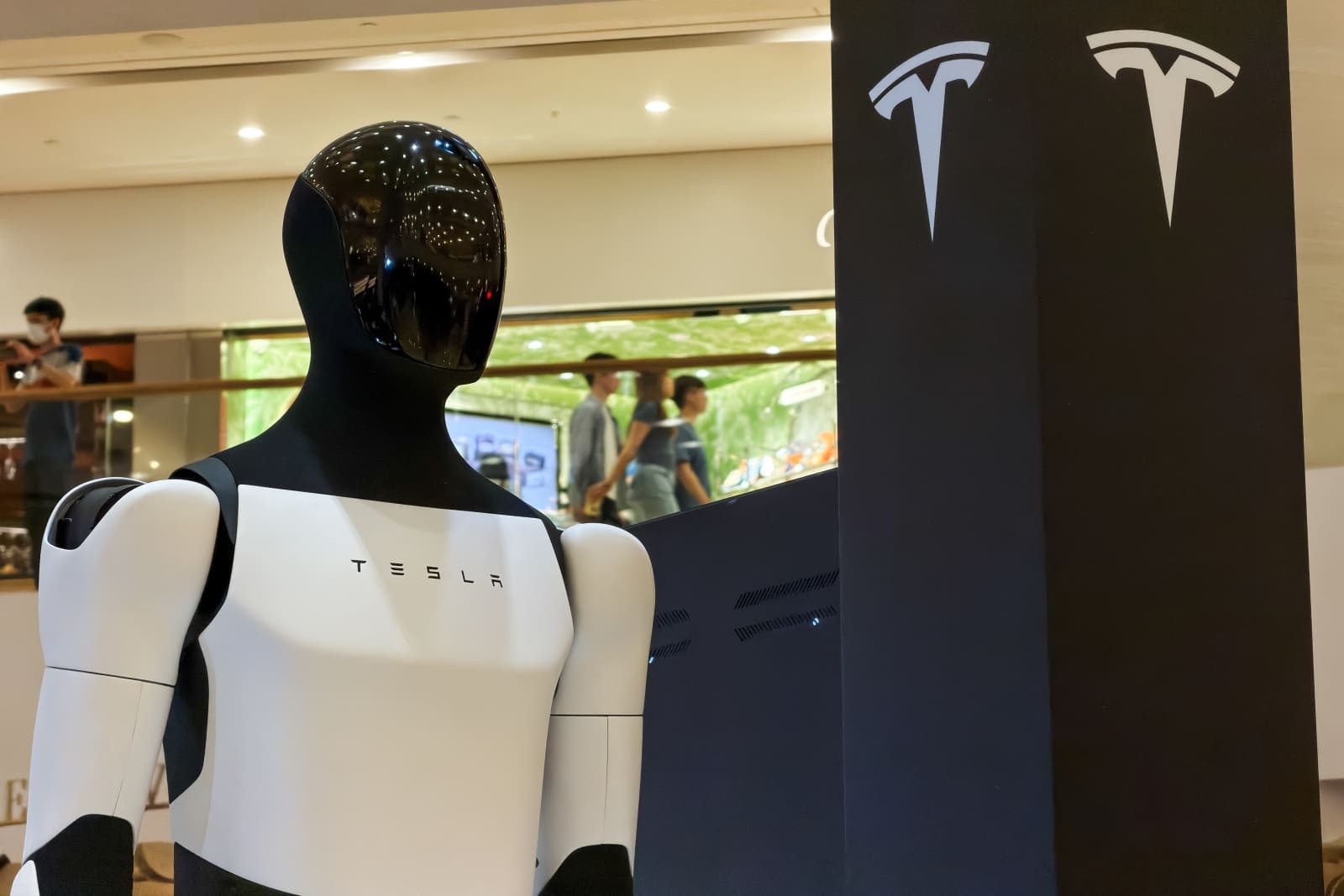
Optimus is another example of a large ambition with substantial work still ahead. Musk described remaining challenges and expectations extending toward the end of 2027. The exhibition photograph accompanying this report shows a public display, not proof that a household robot business is already operating at scale.
Tesla’s quarter offers both a beat and a warning about the limits of a beat. The company exceeded two closely watched forecasts, but its car business, profit and cash generation still face scrutiny. The next assessment will depend on delivered results—not simply the size of the opportunities described on the call.