Gemini wants to handle the small-business paperwork. Check the permissions first.
Google’s new hub brings brand visuals, financial tools and connected apps together in a phased rollout.
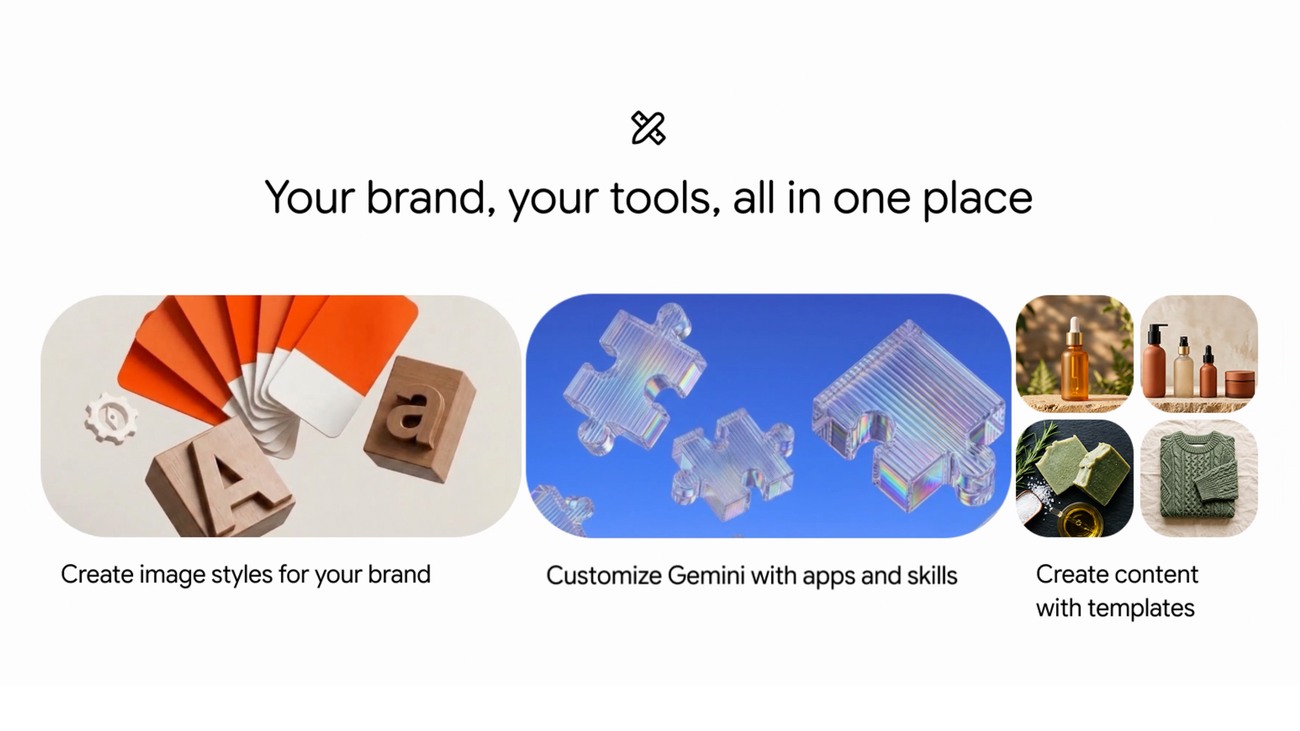
Google wants Gemini to become a small-business workspace, not just a box for asking questions. A new business landing page brings brand creation, financial analysis and connections to existing apps into one hub.
The tools were announced on October 20 and are beginning a global rollout over the following days. Availability can arrive gradually; an announcement for all Gemini app users does not mean every account has every connection switched on at once.
A brand kit that does not need uploading every time
Businesses can supply a website, fonts, color palettes or a brand kit to define a visual style. Google says Gemini can retain that style and use Nano Banana 2.1 to generate more consistent assets for launches and ongoing marketing.
For a small operation without a dedicated design team, that promises less repeated setup. It does not remove the need to check text, product appearance, trademarks or whether an image accurately represents the item being sold.
A visual that matches the palette can still contain a wrong label or an invented detail. Owners remain responsible for what reaches customers, even when the first draft takes seconds.
The spreadsheet promise has a checking requirement
Google says the finance tools can turn receipts, purchase records and untidy spreadsheets into financial graphics and interactive models. The attraction is making information easier to question and understand, rather than forcing an owner to decode every table manually.
A clear chart is not necessarily a correct chart. Totals, dates, currencies and categories should be checked against the original records before a business makes payroll, tax or spending decisions from the output.
The announcement also names connections to Google Business Profile, Google Ads and Workspace, alongside apps including Adobe, Canva, Dropbox, Shopify, Wix, Zoho and Xero. A named integration does not imply that Gemini can perform every action in that service, or that a business has already authorized it to do so.
The examples come from businesses, through Google
In Bordeaux, ceramicist Morgane of Bleu Clémentine uses Gemini for product descriptions, newsletters and social-media hooks. Google says she saves two to three hours a day. That is a company-presented customer example, not an independently measured average saving for every user.
In Maharashtra, farmer and creator Santosh Jadhav used Gemini while planning ginger farming, including questions about soil, seed requirements and investment. Agricultural decisions still depend on local conditions and sound expertise; an anecdote does not validate every recommendation an AI might give a farmer.
Personal organizer Patricia Morais, in Goiânia, uses it for customer service and content creation alongside her local business presence. The three examples show different uses of the same platform, not evidence that every kind of business has the same needs or gets the same return.



A sports space and a burger shop round out the pitch
Google also features Barelz Arena in Jakarta, where Gumilang used Gemini while developing branding, merchandise and partnership proposals for a sports and entertainment space under train tracks.
In New Jersey, Burger & Butcher uses Gemini and a connected Business Profile for tasks such as checking local search performance and drafting updates. The example links content creation with a practical storefront task: keeping the business’s online presence up to date.
These examples are useful because they make the product concrete. They are still selected by the company promoting it, rather than a representative trial of all small businesses.


Connect deliberately, not automatically
Before linking business systems, an owner should check which account is being connected, what information can be read, what actions can be taken and how access can be revoked. Start with non-sensitive material while testing whether the workflow is useful.
The announcement separately points larger organizations toward Gemini Enterprise for centralized administration and governance. That does not make a personal Gemini account equivalent to an enterprise deployment or erase the need to review the applicable data terms.
The hub’s promise is time back. Its value will depend on whether the work stays accurate and whether the permissions fit the business—not on how many apps can be connected in a single afternoon.