Sharks are older than trees—but not because today’s sharks never changed
The shark lineage reaches deep into the fossil record. That does not make a modern shark an unchanged prehistoric survivor.
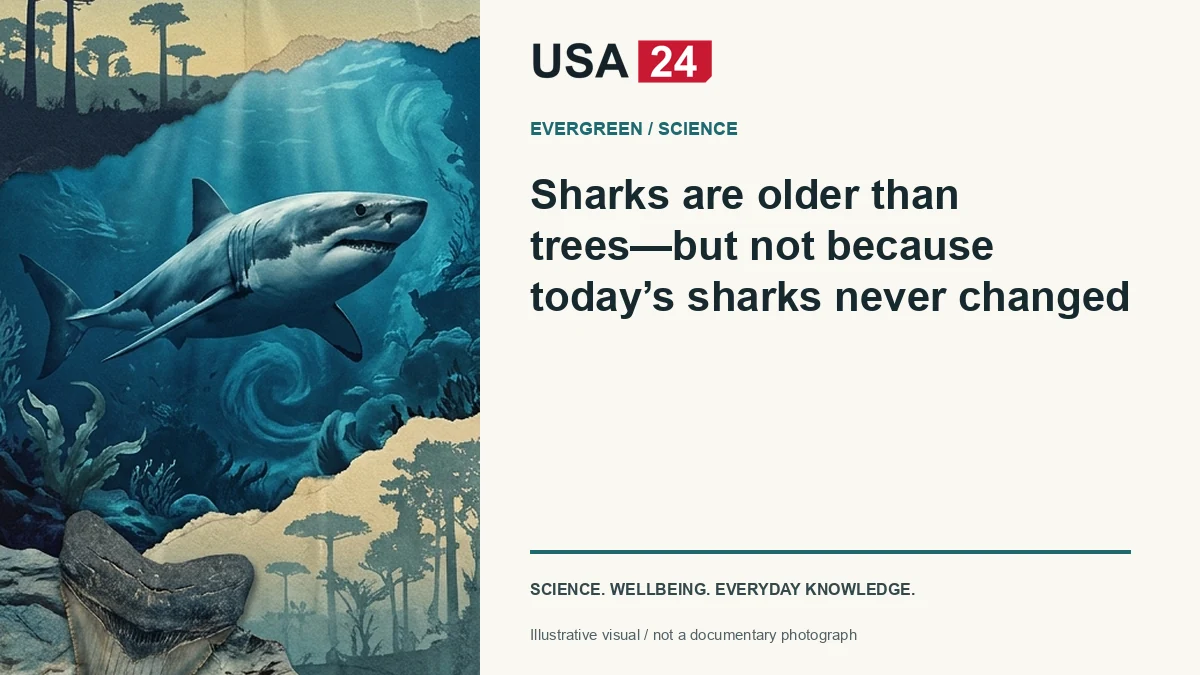
The claim that sharks existed before trees is more than a memorable comparison. It points to the extraordinary age of a lineage whose history stretches back hundreds of millions of years. It also needs one important qualification: a lineage is not the same thing as a modern species.
What the ancient date actually means
London’s Natural History Museum traces shark history across roughly 450 million years. The early fossil record includes small remains such as scales, rather than a complete parade of familiar modern animals.
Evidence for an ancient shark-related lineage does not mean a great white shark in its present form was swimming through every period in that timeline. Ancestors, relatives and modern species occupy different parts of the evolutionary story.
Why the fossil record is uneven
Sharks are cartilaginous fishes: much of their skeleton is cartilage rather than the hard bone familiar from many other vertebrates. Hard parts such as teeth are especially important clues to their past.
Fossils provide evidence, but not an uninterrupted video. The picture becomes more detailed as researchers compare remains, geological ages and anatomical features. Precise claims should reflect those limits.
Ancient does not mean invulnerable
The popular phrase “living fossil” can hide how much shark diversity has changed. Some branches disappeared; others diversified. Modern sharks are the result of evolution, not an exception to it.
Their long history is also not a guarantee of future survival. Saying that a lineage endured earlier environmental crises should never be mistaken for evidence that present-day populations cannot be harmed.